
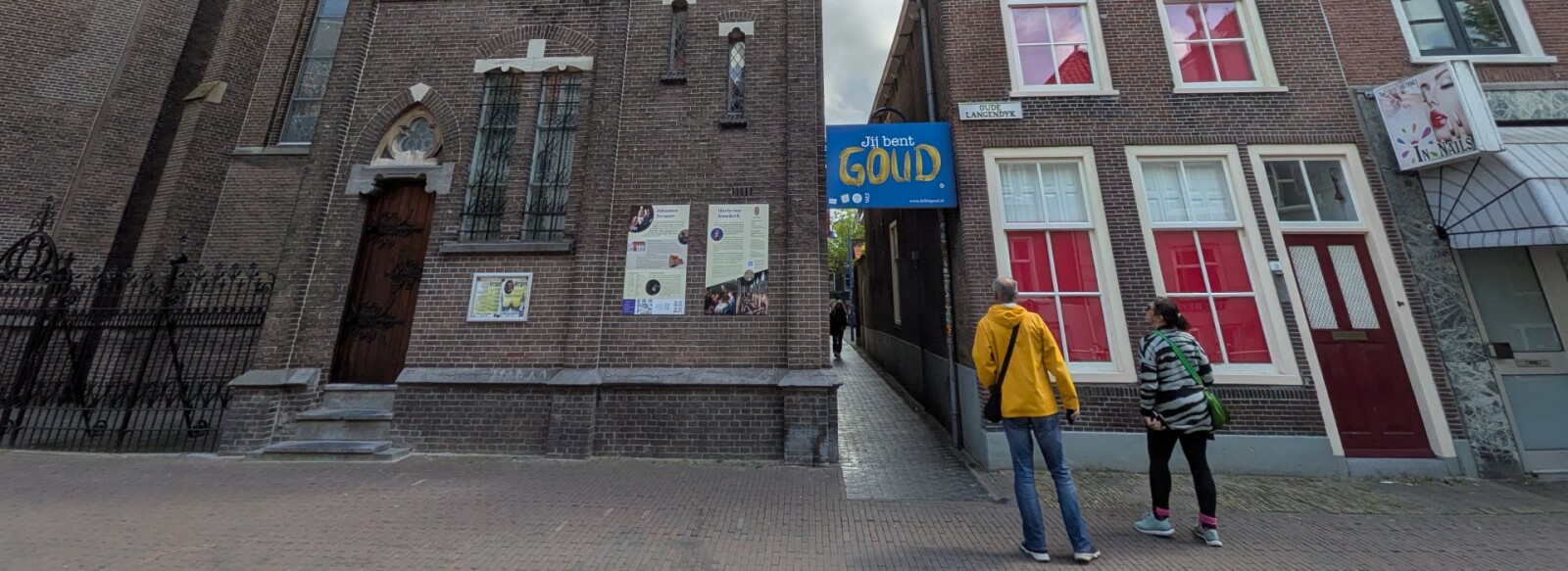
The location: a Catholic refuge
Although Vermeer – who was Protestant by birth – grew up in his father’s inn on the Voldersgracht and later on the Markt, he moved around 1660 to the spacious home of his wealthy mother-in-law, Maria Thins. This property stood on the corner of the Oude Langendijk and the Molenpoort (now Jozefstraat) in the so-called ‘Papenhoek’ – Delft’s Catholic enclave. This was a special place: right next to the house was a Jesuit clandestine church. Today, the Catholic Maria van Jessekerk stands on this site.
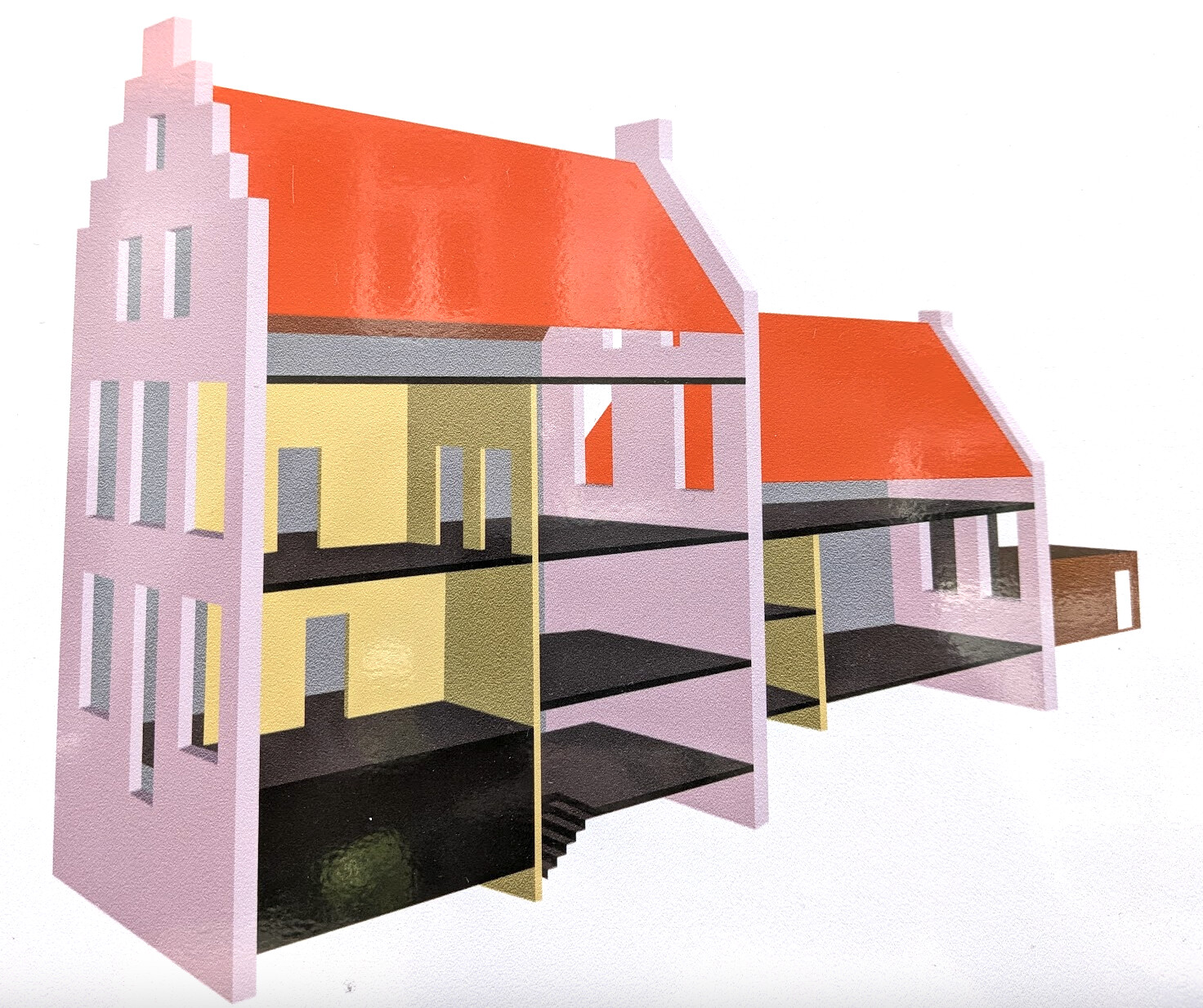
digital sketch of Maria Thins’s house (side view)
What we know about his studio
Thanks to a detailed inventory list, drawn up after his death in 1675, there are certain things we know for certain about his studio. It was located in the front room on the upper floor. In this room there were two easels, three palettes and a wooden screen. Northern light streamed in through the windows here – a crucial detail, as northern light hardly changes in colour or intensity throughout the day, which allowed Vermeer to work on the same colour nuance for hours on end.
What do we not know about his studio?
What we do not know is how Vermeer maintained that serene calm. The house on the Oude Langendijk was home to a large family that eventually had eleven children. How he kept the chaos of a 17th-century household out of his studio remains a mystery.
We are also partly in the dark about his technique. There are indications that he used a camera obscura to study the play of light, but this device does not appear on the inventory list of the Oude Langendijk. It is possible that he came into contact with the camera obscura through the Jesuits at the adjacent Jesuit church and borrowed one from them. Or was his eye simply sharper than any device?
The choice of a single location
It is almost inconceivable to us: an artist who spends his entire adult life in virtually the same rooms. Yet this was Vermeer’s strength. Whilst contemporaries such as Frans Hals or Rembrandt experimented with movement and drama, or painters like Gerard Ter Borch chose to travel, Vermeer opted for depth.
By staying in one place, he became a master of observing light. He knew the reflection of light on the whitewashed walls of the Oude Langendijk inside out. The room was his universe; it was precisely within the confines of that space that he found an unprecedented depth.
The façade on the Oude Langendijk
In the 17th century, Maria Thins’s property was a corner building. The main entrance and the wide façade faced the Oude Langendijk. The studio was situated on this street-facing side on the first floor, allowing Vermeer to benefit from the unobstructed northern light, which was not hindered by buildings directly opposite. The house extended deep to the rear along what was then the Molenpoort (now Jozefstraat). It was a substantial building for its time, but it was nowhere near as long as the current church, which stretches all the way to the Burgwal.
- Then: behind Maria Thins’s house were other plots and smaller dwellings that continued towards the Burgwal.
- Now: the Maria van Jessekerk is a huge neo-Gothic cruciform church. To make way for its construction, several buildings were demolished in the 19th century. The church now stretches all the way from the Burgwal (the front) to the Oude Langendijk (the rear/chancel side).
A lost legacy
Today, the site of Maria Thins’s house is occupied by the neo-Gothic Maria van Jessekerk (built between 1875 and 1882). The original studio has been demolished, but if you stand at the rear of the church, on the Oude Langendijk, you are standing on the exact spot where The Milkmaid and Girl with a Pearl Earring first saw the light of day. At the rear of the church, you will find an information board explaining the historical significance of this location.
The studio on Oude Langendijk reminds us that you don’t have to travel far to discover the universe. Sometimes a single room with good northern light is enough to capture eternity. At the Vermeer Centrum Delft, you will find digital reproductions of all of Vermeer’s works. In 19 of the 37 works, Vermeer’s studio, with its stained-glass windows, can be seen.
Meet the Master of Light in Delft!
Click on this link for tickets.