Mathematical versus optical perspective
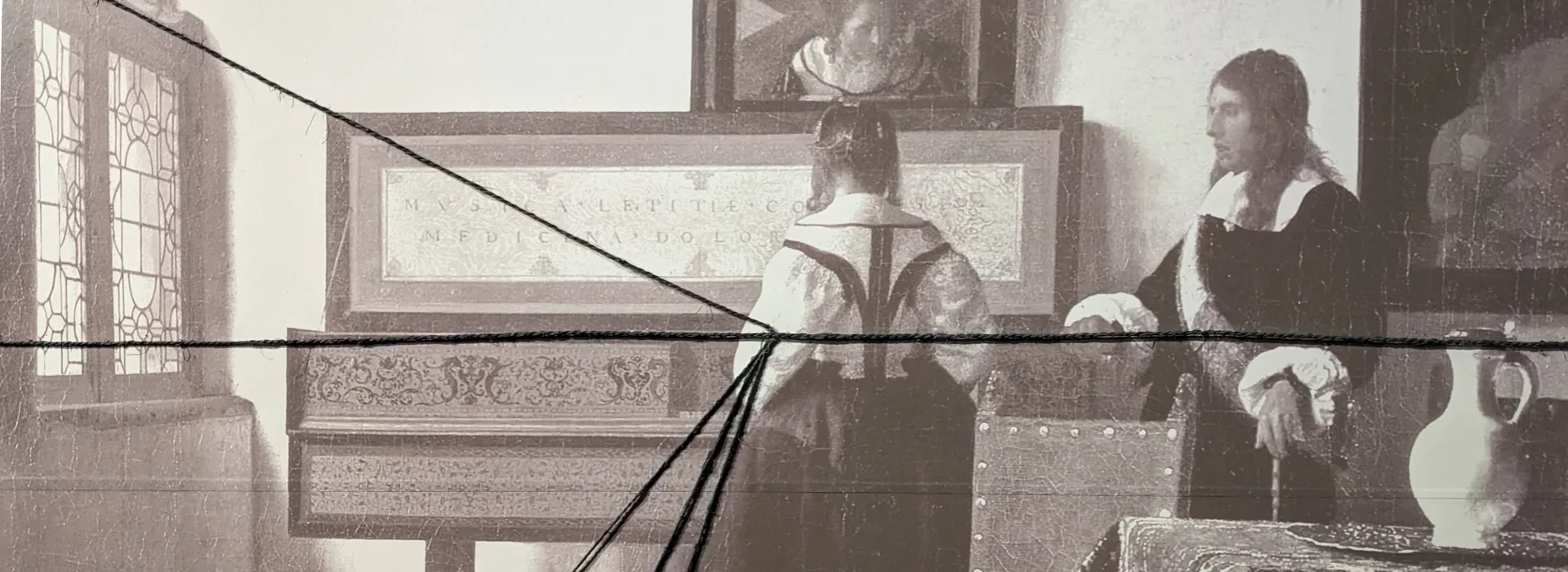
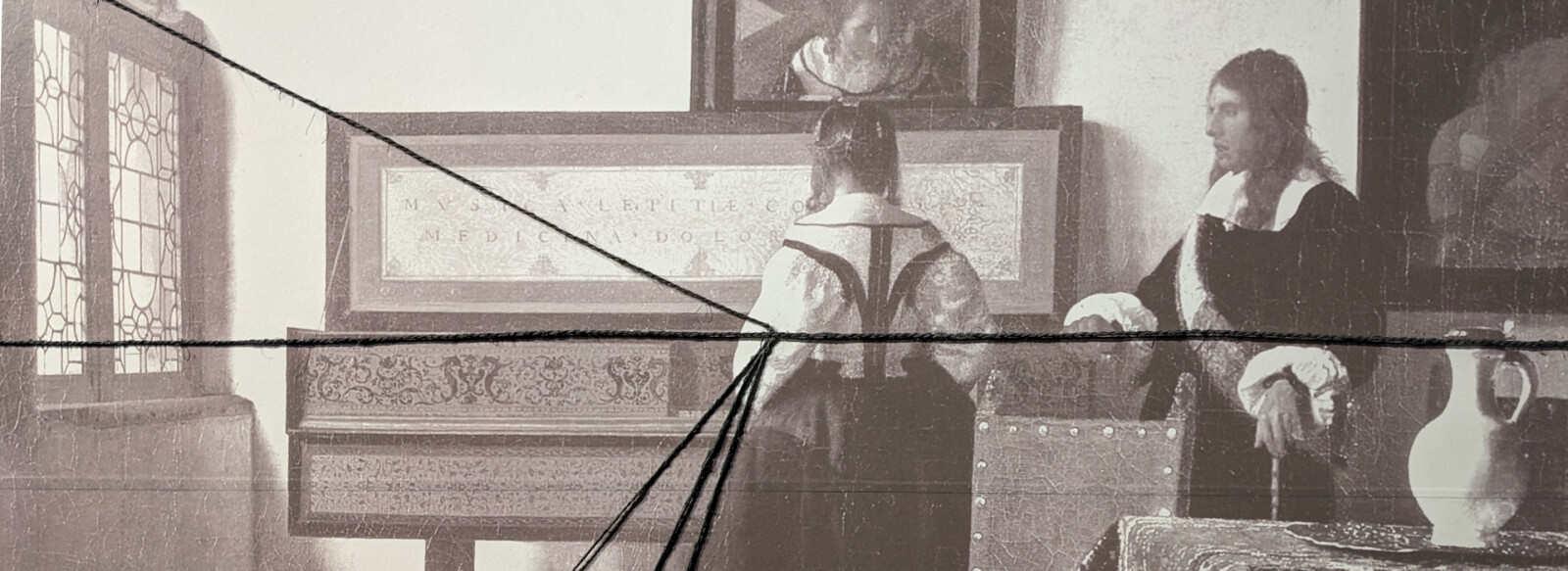
To understand why Johannes Vermeer is considered a solitary genius in the field of perspective, we must make an important distinction: the difference between mathematical perspective (what you draw with a ruler) and optical perspective (what your eye or a lens actually sees).
Most of Vermeer's contemporaries had mastered the mathematical trick perfectly. But Vermeer took it to a higher level by painting not what he knew, but what he saw. Here are the three unique ways in which he broke with the tradition of his time:
1. From line drawing to 'photography'
Almost all painters in the 17th century strove for sharpness. Whether an object was in the foreground or background of the room, it was often painted with equal detail and sharp lines. This is called linear sharpness. Vermeer did something radical: he painted blurring. He imitated the effects of a lens (probably using a camera obscura). This gave his work a quality that we now recognise as “photographic”, but which was revolutionary in his time:
- Depth of field: in paintings such as The Milkmaid, the bread basket and pieces of bread in the foreground are not razor sharp, but grainy, blotchy and soft. The focus is further away, on the woman herself. This forces your eye to focus on the subject, just like a camera lens.
- Circles of diffusion: this is Vermeer's most unique “signature”. When bright light fell on a shiny object (such as a wet ship's hull in View of Delft or the velvet chair in Woman Writing), he did not paint sharp white dots, but blurred, translucent spheres. This is an optical phenomenon that you only see when looking through an (imperfect) lens. No other painter did this at the time.
2. The psychology of the vanishing point
In the work of many of his contemporaries (such as Pieter de Hooch), the perspective is very “open”: you look straight down a corridor or through a door to the outside. The perspective invites you to walk inside. Vermeer, on the other hand, used perspective to maintain distance.
- The viewer's point of view: he often placed his vanishing point in such a way that it suggests that the viewer (us) is sitting or standing in a specific place, often low to the ground.
- The barrier: he almost always combined his perfect lines with an obstacle in the foreground (a curtain, a table, a chair). The perspective “sucks” you into the room, but the obstacle stops you. This creates that typical tension: you are close, but you must not disturb. It makes the viewer a voyeur rather than a visitor.
3. Colour as depth
In addition to lines, Vermeer masterfully used colour to suggest depth, something called atmospheric perspective. Instead of simply making shadows black or brown (which was common), he understood that shadows have colour. In The Milkmaid, the shadows on the white wall are not grey, but soft blue. This suggests air and space between the viewer and the wall. He constructed his space not only with lines, but with particles of light.
What makes Vermeer's perspective unique?
What is special about Vermeer is the combination of two techniques:
- He used the pin and string for a rigorous, mathematically perfect basis (the “skeleton” of the painting).
- On top of that, he added the optical effects of the camera obscura (the “skin” of the painting).
As a result, his rooms do not feel like painted backdrops (as with many of his contemporaries), but like living spaces where light really moves through.
Johannes Vermeer was more than a painter; he was a director of our gaze. By combining mathematical and optical perspective, he constructed spaces that feel lifelike. His perspective compels us to look at what he considered important, and centuries later, we still find ourselves lost in his tranquil Delft interiors.
On the second floor of Vermeer Centrum Delft, you will find the “Vermeer Studio”, where we reveal the secrets of Vermeer's painting.