
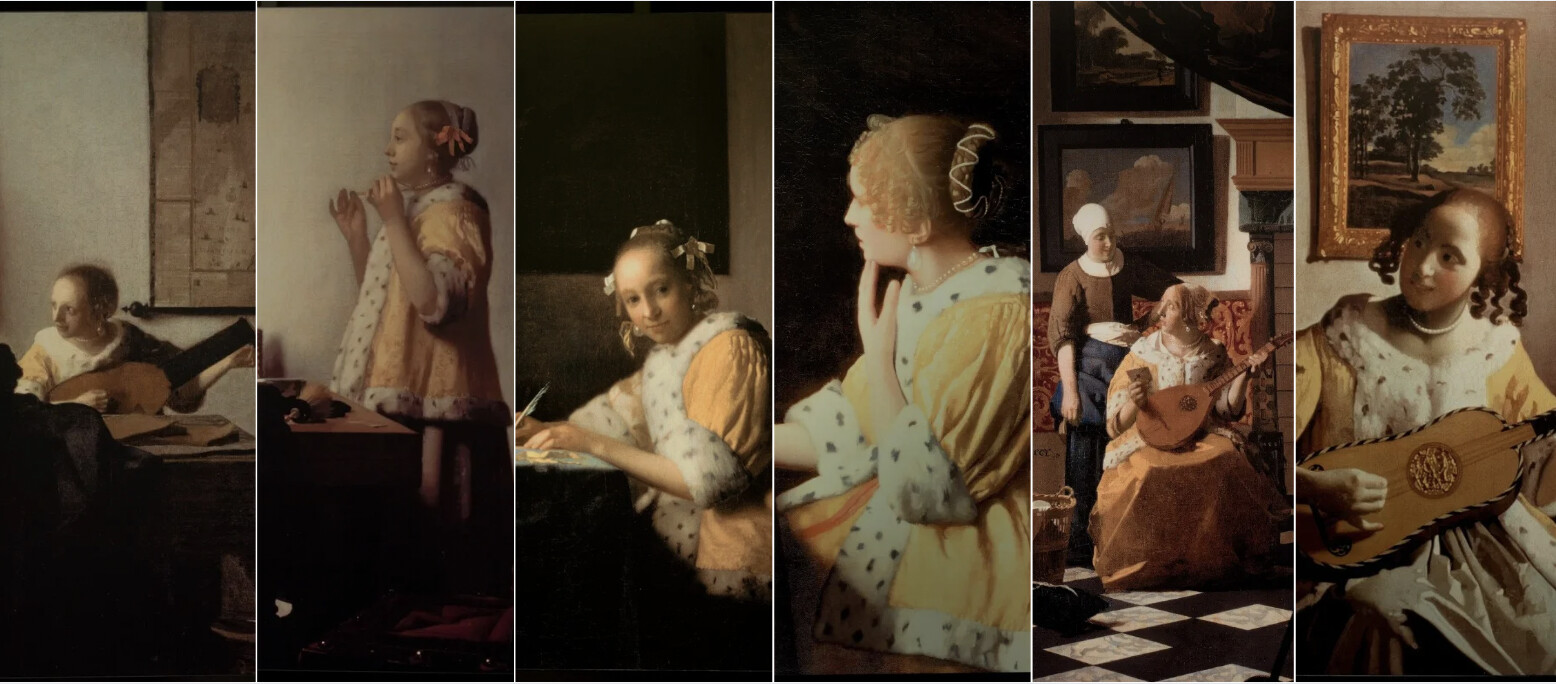
While contemporaries such as Rembrandt often dressed their models in ever-changing, dramatic robes, Vermeer kept returning to this one cloak. He draped it over the shoulders of a woman writing, a lute player and a lady admiring her pearls. Why was the painter so obsessed with this particular garment?
The “uniform” of the Delft Master
Thanks to an inventory drawn up after Vermeer's death in 1675, we know that this cloak was not a figment of his imagination. Among the possessions of his wife, Catharina Bolnes, was indeed an “Oude geele satijne mantel met een witte hontsvelkant” (old yellow satin cloak with white fur trim). The cloak was therefore a tangible part of their daily life.
But why did Vermeer choose to immortalise this particular item time and time again? Here are three possible reasons:
1. A masterclass in lighting
Vermeer was known as the “Master of Light”. Yellow satin is a technically challenging fabric; it shines, reflects and captures the cool light from the Delft windows in a unique way. By contrasting the smooth texture of the satin with the soft, matte structure of the white fur, Vermeer was able to demonstrate his virtuosity. He did not paint a cloak; he painted how light behaves on different materials.
2. Status and domestic bliss
In the 17th century, yellow was a bold and expensive colour. Wearing satin and fur was reserved for the wealthy bourgeoisie. By dressing his models in this cloak, Vermeer immediately gave the women in his paintings an aura of wealth and elegance.
3. The power of repetition
Vermeer worked incredibly slowly, often producing only two or three paintings a year. By repeatedly using the same “props” – such as the yellow cloak, the marble floor or the lion's head chairs – he created a recognisable universe. It gives his oeuvre a serene continuity. As viewers, we feel as if we are entering the same room again and again, but each time we catch a different intimate moment.
The yellow satin cloak with white fur trim can be seen in the following works:
- The Lute Player (1662-1664)
- Woman with a Pearl Necklace (1662-1664)
- Woman Writing in Yellow (1664-1667)
- Lady and Maid (1664-1667)
- The Love Letter (1669-1670)
- The Guitar Player (1670-1672)
The yellow cloak is more than fashion; it is the common thread running through the work of a man who sought perfection in the everyday. It reminds us that a great artist does not need a palace full of props to create magic—sometimes a single cloak and the right light are enough for eternity.
Would you like to discover the yellow cloak and Vermeer's other secrets with your own eyes? At the Vermeer Centrum Delft, you can literally step into the world of the master. Discover the stories behind his masterpieces and learn all about his use of colour and techniques. A must-visit for every Vermeer enthusiast!
Plan your visit via this link.