
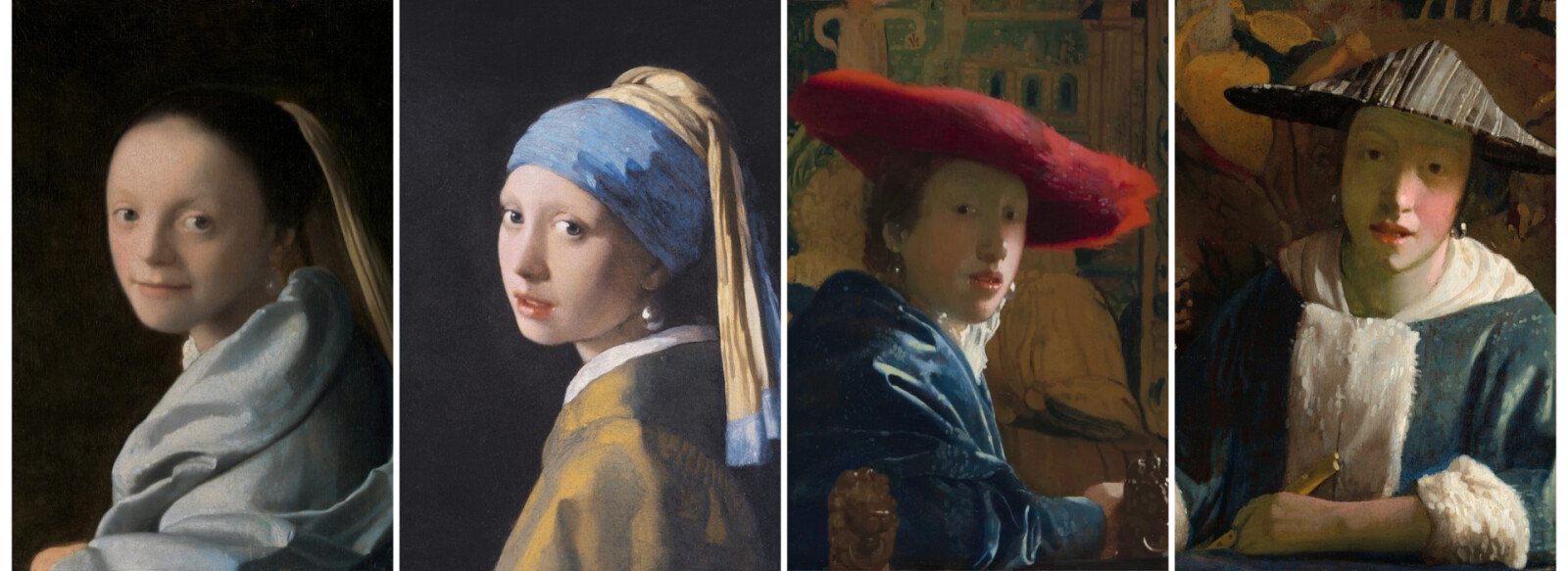
What is a tronie?
The word derives from the Old French trogne (head or face). Whilst formal portrait commissions from patricians were bound by strict conventions of status, piety, rank and social class, the tronie offered painters artistic licence. The focus was not on the subject’s family tree, but on how an expressive facial expression or a human type was depicted. Painters liked to dress their models in theatrical, historical or Oriental attire to demonstrate their mastery of light and texture.
For Vermeer, the tronie meant pure concentration on the play of light, the texture of fabrics and emotional stillness. Thanks to his most important patron in Delft, Maria de Knuijt (together with her husband Pieter van Ruijven), he enjoyed the trust and financial backing to work on a single canvas for extended periods. She encouraged his innovative work and eventually acquired around half of his entire body of work. At the famous Dissius auction of 1696, at which the couple’s collection was sold, at least three ‘ongeheel konstige’ (exceptionally skilful) ‘tronies’ by Vermeer appeared.
All of Vermeer’s ‘tronies’
Within Vermeer’s compact body of work, comprising some 37 surviving canvases, the ‘tronies’ occupy a special place. Art historians generally include four key works in this category:
- Girl with the Red Hat (c. 1669, National Gallery of Art, Washington D.C.): painted on a small wooden panel, renowned for the flamboyant red feathered hat and the bold chiaroscuro (marked contrast between light and dark).
- Girl with a Flute (c. 1669–1675, National Gallery of Art, Washington D.C.): depicted wearing a conical hat and holding a recorder.
- Study of a Young Woman (c. 1665–1667, Metropolitan Museum of Art, New York): a young woman’s face with a vulnerable expression, set against a dark background. Often regarded as a counterpart to Girl with a Pearl Earring.
- Girl with a Pearl Earring (c. 1665, Mauritshuis, The Hague): the most famous portrait of a girl wearing an oriental turban, rendered in rich ultramarine and featuring the iconic pearlescent sheen.
Between fact and theory: suggestions from Graham-Dixon
Who posed for these works? The romanticised image of a maid in love – familiar from Tracy Chevalier’s novel – has long been dismissed by historians as a myth. Yet there is a complete lack of concrete evidence regarding the actual models in the archives.
In his biography Vermeer: A Life Lost and Found, art critic and author Andrew Graham-Dixon puts forward a provocative hypothesis. He reminds us that Vermeer worked amidst a bustling household with eleven children in the home of his wealthy mother-in-law, Maria Thins. Graham-Dixon argues that Vermeer did not have to look far: his growing daughters, particularly his eldest daughter Maria and perhaps her sister Elisabeth, would have been exactly the right age to pose for these studies around 1665. He also puts forward the theory that Maria was trained by her father and may have been involved in the painting of Girl with a Flute.
It is a theory that sounds logical and captures the imagination, but is received with due caution in academic art history. After all, there is no contemporary evidence, diary entry or studio note to confirm that Vermeer’s daughters ever posed for him – let alone that Maria painted. It remains an intriguing assumption; an interpretation that fills in the gaps in Vermeer’s biography, but is by no means an established historical fact. The model may just as easily have been another family member, a neighbour’s daughter or a composite idealised image (tronie).
What material analysis (such as that of Girl in the Spotlight at the Mauritshuis) does conclusively demonstrate, however, is that Vermeer worked from a live model. He observed subtle, fleeting optical effects with phenomenal precision: the camera obscura-like blurring along the line of the nose, the damp speckles on the lower lip and the soft reflection of the white collar in the glass earring.
Why do they continue to appeal so much?
Whilst contemporaries such as Rembrandt or Frans Hals often sought to capture a weathered, theatrical or grotesque character in their portraits, Vermeer opted for a charged intimacy. His models do not gaze at us passively: they catch our eye with a casual glance over their shoulder, their lips parted by a fraction of a millimetre as if they are about to speak.
It is precisely this elusiveness that makes them timeless. Whether we are looking at his daughter Maria Vermeer or an anonymous girl from Delft whom we shall never know: thanks to the patron Maria de Knuijt, who gave Vermeer the artistic freedom to refine these non-commercial studies, their appeal remains undiminished after more than 350 years.
Visit the Vermeer Centrum Delft and admire digital reproductions of the various ‘tronies’ all together. Click on this link for online tickets.