
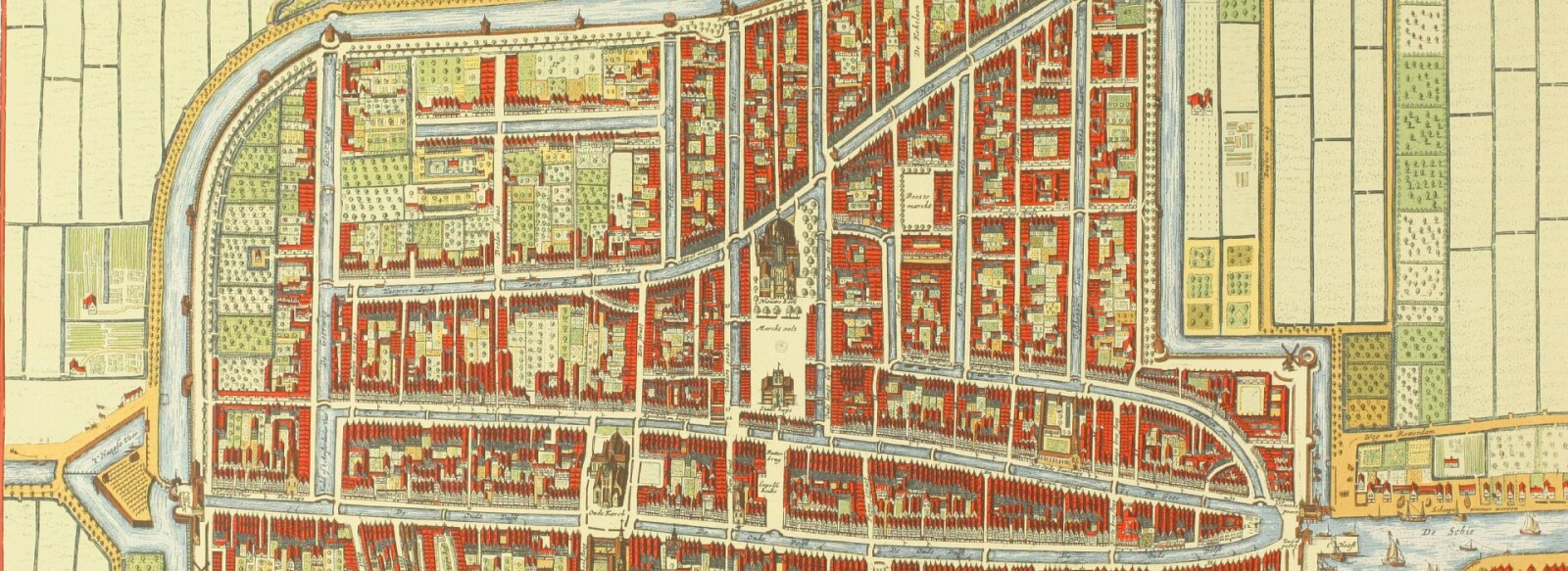
Walk through Vermeer’s living canvas
Although his own studio has not stood the test of time, the physical locations where he was trained, lived and found his inspiration can still be traced. In this blog post, we take you on a tour of the places that tell the story of his mastery and his legacy.
1. Voldersgracht 25: the birthplace
Our journey begins on the Voldersgracht. At number 25 stood the house known as ‘De Vliegende Vos’. This is where Johannes Vermeer was born in 1632. His father, Reynier Jansz, ran an inn here and worked as an art dealer and weaver. It was the place where Johannes spent his earliest years and where the creative spark was likely ignited.
2. Markt 54-56: Herberg Mechelen
Vermeer was still a young boy when the family moved to the Markt. His father bought the large Herberg Mechelen, situated on the corner of the Markt and the Oude Manhuissteeg. This is where Vermeer grew up. Mechelen was a bustling place full of activity, travellers and art dealers. It was in this inn that Johannes came into contact with the paintings his father traded in, which greatly influenced his decision to become an artist. In 1885, the building on this site was demolished to widen Oude Manhuissteeg. A commemorative plaque hangs on the façade of Markt 52 to mark this, although it incorrectly states that Johannes Vermeer was born here.
3. Markt 34: Het Gulden ABC
Next to the town hall, on the Markt, we find one of the most important locations in Vermeer’s history: ‘Het Gulden ABC’. In the 17th century, this building housed a bookbindery and printing house and was run by Jacob Dissius.
The story behind this place is unique. Jacob Dissius married Magdalena van Ruijven in 1680. She was the daughter of Pieter van Ruijven and Maria de Knuijt: the wealthy patrons who financially supported virtually the entirety of Vermeer’s career and were his most important clients. When Magdalena’s parents died, she inherited their enormous art collection. Following her untimely death in 1682, the collection passed entirely into the hands of her husband, Jacob Dissius.
This means that no fewer than 21 original Vermeer paintings once hung in the rooms of Het Gulden ABC on the Markt. According to an old inventory, eleven hung in the front room, four in the back room, one in the kitchen and two in the cellar. So more than half of Vermeer’s entire oeuvre hung in this single building on the Markt! After Dissius’s death, these 21 masterpieces were definitively scattered across the world during a legendary auction in Amsterdam in 1696.
4. Vlamingstraat 40-42: Vermeer’s Little Street
For a long time, it was one of the greatest mysteries in the art world: where did Vermeer paint his famous ‘Little Street’? Following in-depth archival research, the location has been definitively established as Vlamingstraat, at what are now numbers 40 and 42.
Although the 17th-century houses themselves have been replaced over the centuries, the narrow passageway (the ‘Penspoort’) that still runs between them provides a wonderful glimpse of the spatial layout that Vermeer captured at the time. It is a place where the everyday beauty of historic Delft becomes tangible.
5. Oude Langendijk: the studio
After his marriage to Catharina Bolnes, Vermeer moved to the ‘Papenhoek’—Delft’s Catholic enclave. They moved in with his wealthy mother-in-law, Maria Thins, in a large corner house on the Oude Langendijk (on the corner of Jozefstraat).
This is the place where his masterpieces were actually created. Thanks to an old inventory list, we know that his studio was located in the front room on the first floor. The windows looked out over the Oude Langendijk, meaning the room was perfectly lit by the constant, cool northern light we recognise from The Milkmaid and Girl with a Pearl Earring.
The house was demolished in the 19th century to make way for the current Maria van Jessekerk. The huge church was built ‘inversely’ to the old houses: the main entrance is on the Burgwal, but the rear (the chancel) stands exactly on the foundations of the studio on the Oude Langendijk.
6. De Hooikade: View of Delft
For his most iconic outdoor view, we must head to the south side of the city, to the Hooikade. This is where Vermeer stood when he sketched out his world-famous ‘View of Delft’. Although the large city gates depicted in the painting have since been demolished, the outline of the Kolk remains virtually unchanged. Standing here, you can see exactly how the sun’s rays dance across the water and the rooftops—a photographic effect that Vermeer mastered like no other.
7. Oude Kerk: the final resting place
We end the walk at the Oude Kerk, the striking church with the leaning tower. This is where the master of light is buried. Although his exact gravestone has been lost over the centuries, a simple memorial stone has been placed in the north aisle choir. It is a serene spot to reflect on a man who never left Delft, yet made the city world-famous.
Whilst his contemporaries travelled the world to Italy or England in search of fortune and adventure, Vermeer remained within the familiar walls of his own city. From his birthplace on the Voldersgracht to his studio on the Oude Langendijk and the treasure trove in ‘Het Gulden ABC’ on the Markt: his entire universe spanned just a few hundred metres. But it was precisely because of this extreme confinement that he was able to delve into the depths. He sought eternity in the everyday light of Delft, and found it there.
Take the Vermeer walk through Delft
If you too would like to see Delft through Vermeer’s eyes, you can buy the walking guide ‘Vermeer’s Delft’ for €3.00 at the counter of the Vermeer Centrum Delft.