
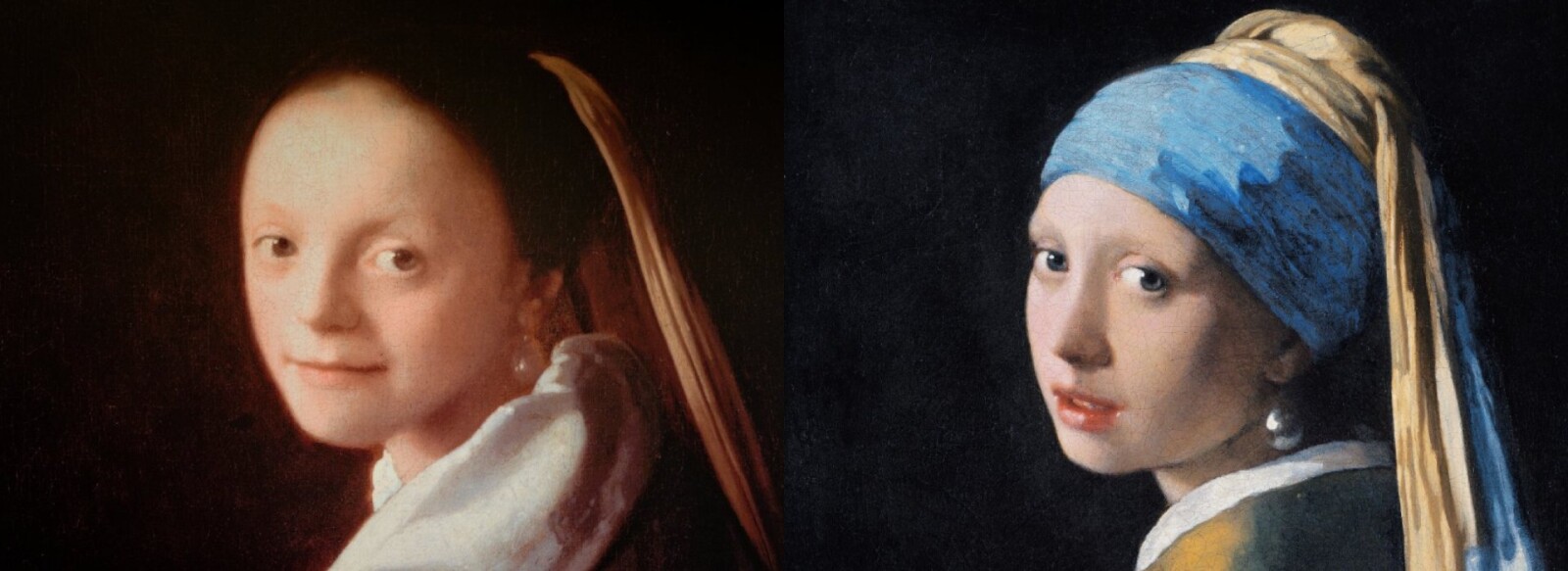
In art history, these works are classified as tronies: not portraits of specific people commissioned by others, but studies of character, facial expression and exotic clothing.
Graham-Dixon's vision: beauty and the “strange”
Graham-Dixon argues that Vermeer almost certainly painted these two canvases as counterparts. He even calls them the “ideal diptych” for understanding Vermeer's obsession with human facial expressions.
1. Visual composition
The two paintings are almost identical in design, but mirrored:
- The pose: both women look over their shoulders at the viewer against a deep black, empty background.
- The light: in Girl with a Pearl Earring, the light comes from the left and she turns her face towards it. In Study of a Young Woman, the light also comes from the left, but falls on the back of her head and the side of her face, creating a more diffuse and mysterious effect.
2. The ideal vs. character
Graham-Dixon points out a fascinating contrast in the “beauty” of the models:
- Girl with a Pearl Earring: she represents an almost supernatural, classical beauty. Her features are soft, her lips moist and parted, and her turban makes her exotic and unapproachable.
- Study of a Young Woman: Graham-Dixon often describes her as “less conventionally beautiful”. She has a broader face, wide-set eyes and an almost curious, slightly uncomfortable expression.
The meaning: according to the author, Vermeer wanted to show that he could capture both “ideal beauty” and “peculiar, individual humanity”. One girl is a dream, the other is a person.
3. The pearl as a connecting element
In both paintings, an enormous pearl plays the leading role. Graham-Dixon emphasises that these pearls (which were probably made of glass, given their unnatural size) function as an optical anchor:
- In the famous girl, the pearl enhances her radiance.
- In the “study”, the pearl draws attention to her neck and the texture of her skin.
The “lost” connection
What Graham-Dixon finds particularly interesting is that these two works probably hung together in the collection of patron Pieter van Ruijven and his wife Maria de Knuijt. For a 17th-century viewer, comparing these two faces was an intellectual exercise: it was a meditation on how light reveals different forms of beauty.
He even suggests that the girl in the Study may have been one of Vermeer's own daughters, while the Girl with a Pearl Earring is a more abstract fantasy figure. By hanging them side by side, Vermeer connected his own world with the world of imagination. In his book “Vermeer: A Life Lost and Found”, Graham-Dixon attempts to restore the lost connection by placing the paintings side by side again. He invites you to look at the invisible threads that connect the works. Andrew Graham-Dixon's book is on sale in the museum shop of the Vermeer Centrum Delft.
In the renewed arrangement of Vermeer's works at the Vermeer Centrum Delft, the two works “Study of a Young Woman” (1664-1667) and “Girl with a Pearl Earring” (1664-1667) hang right next to each other. How do you view these works now, with Andrew Graham-Dixon's suggestions?
Plan your visit to the Vermeer Centrum Delft via this link.